Are you looking for;
Business Website
News Portal
Digital Intergration
AI Solutions
Call +260 976344260
Business Website
News Portal
Digital Intergration
AI Solutions
Call +260 976344260

by admin on | 2025-12-03 04:47:33
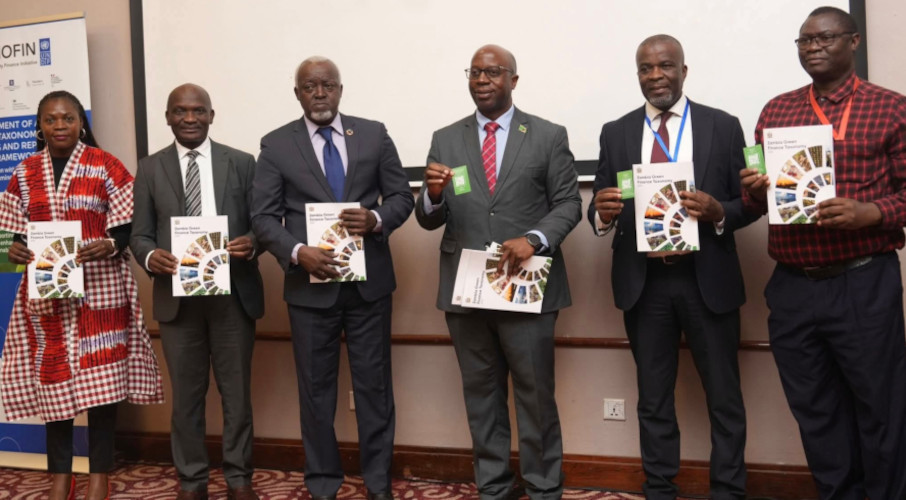
Zambia has formally launched the Zambia Green Finance Taxonomy, a landmark policy tool expected to transform the country’s financial landscape and accelerate investment in environmentally sustainable sectors.
The taxonomy was unveiled in Lusaka by the Permanent Secretary in the Ministry of Green Economy and Environment, Dr. Douty Chibamba, on behalf of Green Economy Minister Mike Mposha.
The launch marks a major milestone in Zambia’s pursuit of a climate-resilient and inclusive green economy.
Minister Mposha described the taxonomy as “a profound statement of intent, commitment, and ambition”, noting that it aligns with the Eighth National Development Plan, Vision 2030, the country’s Nationally Determined Contributions, and the Kunming–Montreal Global Biodiversity Framework.
Mposha emphasized that Zambia’s natural capital—its forests, watersheds, minerals, fertile soils and biodiversity—remains central to economic development but is increasingly threatened by climate change, land degradation and biodiversity loss.
The taxonomy, Mposha said, provides a standardized framework for identifying and classifying environmentally sustainable economic activities, giving investors clarity and boosting confidence in green financing products such as green bonds, green loans and sustainability-linked instruments.
The Minister hailed the collaborative effort behind the taxonomy, acknowledging the support of UNDP, the Biodiversity Finance Initiative (BIOFIN), the Bank of Zambia, the Securities and Exchange Commission, the Pensions and Insurance Authority and financial sector stakeholders.
Mposha urged financial institutions to embrace the tool as a strategic asset rather than a compliance obligation.
And UNDP deputy resident representative Dr. Laurent Rudasingwa, underscored the urgency of mobilizing sustainable finance to address climate shocks, ecosystem degradation and the enormous funding gap needed to implement Zambia’s environmental strategies.
According to recent estimates, Zambia requires USD 42 billion by 2030 to implement green growth and environmental frameworks.
Dr. Rudasingwa said the taxonomy provides a “credible system for identifying truly green activities” across eight priority sectors including renewable energy, sustainable agriculture, forestry, transport, water management and waste management.
The tool, Dr. Rudasingwa added, will help attract both domestic and international capital by reducing transaction risks and improving transparency for investors.
WWF Zambia, represented by Chief Operating Officer Mr. Bruce Mushipi on behalf of Country Director Mrs. Naluha Nganga-Ziba, called the taxonomy a “landmark for Zambia’s financial system and a major step in positioning the country as a regional leader in sustainable finance.”
Mrs. Nganga-Ziba said the taxonomy will help curb greenwashing, strengthen regulatory oversight and unlock financing for nature-based solutions and climate-smart development.
Mr. Mushipi highlighted the role of WWF’s Mobilising More for Climate (MoMo4C) Programme, which supported WWF’s technical contribution to the taxonomy’s development.
Mushipi stressed the need for strong adoption, capacity building and integration of the taxonomy into financial decision-making.
The launch event concluded with a call for all stakeholders—including regulators, academia, financial institutions and development partners—to support training, data systems and disclosure frameworks to ensure effective implementation.
The Zambia Green Finance Taxonomy is now available digitally via a QR code distributed by the ministry with support from UNDP and BIOFIN.
Permanent Secretary Dr. Chibamba formally declared the taxonomy launched, describing it as a tool that “strengthens Zambia’s ability to build a resilient, inclusive and nature-positive economy while attracting sustainable investment at scale.”
Visits: 1014











CopyRight Coldreed Design and Developed by Yesebill 2026